Privileges of office
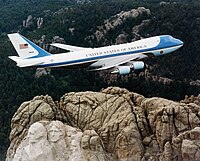
The president is entitled to use the White House as his living and working quarters, and its entire staff and facilities, including medical care, kitchen, housekeeping and security staff. While traveling, the president is able to conduct the functions of the office from one of two custom-built Boeing 747 aircraft, known as Air Force One.[8] The president also utilizes a United States Marine Corps helicopter, designated Marine One when the president is aboard. Similarly, "Navy One", "Army One", and "Coast Guard One" are the call signs used if the president is aboard a craft belonging to these services.[9] For ground travel, the president uses an armored presidential limousine, currently a heavily modified Cadillac DTS which uses the call sign "Cadillac One".
Salary
The First U.S. Congress voted to pay George Washington a salary of $25,000 a year, about $566,000 in 2008 terms. Washington, already a wealthy man, refused to accept his salary; however, he asked for his living expenses to be covered. Theodore Roosevelt spent his entire $50,000 salary on entertaining guests at the White House.[10] John F. Kennedy donated his salary to charities.[11]
Traditionally, the president is the highest-paid public employee. President Bush currently earns $400,000 per year, along with a $50,000 expense account, a $100,000 nontaxable travel account, and $19,000 for entertainment.[2] The president's salary and total expense account serve as an unofficial cap for all other federal officials' salaries, such as that of the Chief Justice. The most recent raise in salary was approved by Congress and President Bill Clinton in 1999 and came into force in 2001; prior to the change, the president earned $200,000, plus expense accounts. This was needed because other officials who received annual cost-of-living increases had salaries approaching that of the president, and in order to raise their salaries further, his needed to be raised as well. Monetary compensation for the president is minuscule in comparison to the CEOs of most Fortune 500 companies and comparable to that of certain kinds of professionals, such as attorneys and physicians in some parts of the United States. Overall the vast majority of U.S. presidents were very affluent upon entering office and thus were not dependent on the salary.
Date established
Salary
Salary in 2007
dollars
September 24, 1789
$25,000
$566,000
March 3, 1873
$50,000
$865,000
March 4, 1909
$75,000
$1,714,000
January 19, 1949
$100,000
$875,000
January 20, 1969
$200,000
$1,135,000
January 20, 2001
$400,000
$471,000
Prior to passage by Congress of the Former Presidents Act (FPA) in 1958, retired presidents did not receive a pension. All living presidents in 1959 began to receive a pension of $25,000 per year, an office, and a staff. The pension has increased numerous times with Congressional approval. Retired presidents now receive a pension based on the salary of the current administration's cabinet secretaries (Executive Level I), which is $183,500 as of 2007.[15] Some former presidents have also collected congressional pensions.[16] The FPA, as amended, also provides former presidents with travel funds and mailing privileges.
Salary
The First U.S. Congress voted to pay George Washington a salary of $25,000 a year, about $566,000 in 2008 terms. Washington, already a wealthy man, refused to accept his salary; however, he asked for his living expenses to be covered. Theodore Roosevelt spent his entire $50,000 salary on entertaining guests at the White House.[10] John F. Kennedy donated his salary to charities.[11]
Traditionally, the president is the highest-paid public employee. President Bush currently earns $400,000 per year, along with a $50,000 expense account, a $100,000 nontaxable travel account, and $19,000 for entertainment.[2] The president's salary and total expense account serve as an unofficial cap for all other federal officials' salaries, such as that of the Chief Justice. The most recent raise in salary was approved by Congress and President Bill Clinton in 1999 and came into force in 2001; prior to the change, the president earned $200,000, plus expense accounts. This was needed because other officials who received annual cost-of-living increases had salaries approaching that of the president, and in order to raise their salaries further, his needed to be raised as well. Monetary compensation for the president is minuscule in comparison to the CEOs of most Fortune 500 companies and comparable to that of certain kinds of professionals, such as attorneys and physicians in some parts of the United States. Overall the vast majority of U.S. presidents were very affluent upon entering office and thus were not dependent on the salary.
Date established
Salary
Salary in 2007
dollars
September 24, 1789
$25,000
$566,000
March 3, 1873
$50,000
$865,000
March 4, 1909
$75,000
$1,714,000
January 19, 1949
$100,000
$875,000
January 20, 1969
$200,000
$1,135,000
January 20, 2001
$400,000
$471,000
Prior to passage by Congress of the Former Presidents Act (FPA) in 1958, retired presidents did not receive a pension. All living presidents in 1959 began to receive a pension of $25,000 per year, an office, and a staff. The pension has increased numerous times with Congressional approval. Retired presidents now receive a pension based on the salary of the current administration's cabinet secretaries (Executive Level I), which is $183,500 as of 2007.[15] Some former presidents have also collected congressional pensions.[16] The FPA, as amended, also provides former presidents with travel funds and mailing privileges.


No comments:
Post a Comment